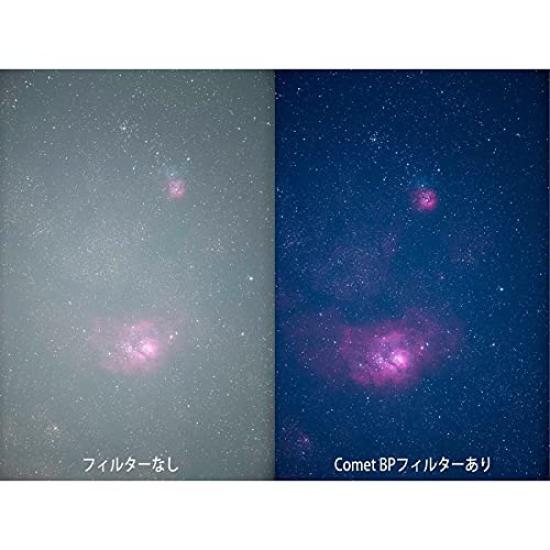
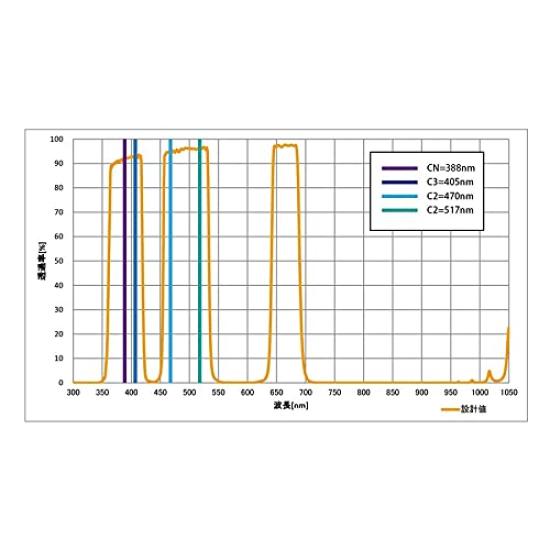
Transmits the emission lines of comets It transmits the wavelength range around the four main emission lines emitted by celestial bodies, Hα, Hβ, OIII, and SII, and also transmits the emission lines near CN, C2, and C3 of the comet's core and tail, and cuts out other wavelengths, making comets and nebulae visible even in light-polluted areas.
Uses synthetic quartz glass with reliable domestic quality.Multilayer films are deposited on both sides of the highly precisely polished synthetic quartz glass base using IAD (ion assisted deposition) coating by a major Japanese vapor deposition manufacturer. The membrane surface boasts high density, homogeneity, and stability.
Highly versatile 48mm/52mm diameter We offer highly versatile filter thread diameters of 48mm and 52mm. It can be used with many commercially available telescopes.
Note:
*It may not be possible to install depending on the telescope or lens.
*The characteristics of this product depend on the incident angle of the light beam. To ensure proper performance, we recommend using it with a telephoto lens or telescope. When using a wide-angle lens, the brightness and color balance will be uneven on the screen.
*Please use commercially available image processing software to adjust the color balance of the images you have taken.
*Product specifications may change without notice. Thank you for your understanding.
[Attractive Features / Recommended Points]
- Ensures reliable transmission of key emission lines important for astrophotography: Hα, Hβ, O III, and S II, while also covering comet coma and tail emission lines: CN, C₂, and C₃.
- Enhances contrast of celestial objects even under low-altitude, urban, or light-polluted conditions where faint objects can be overwhelmed.
- High-quality Japanese manufacturing: Built on synthetic quartz glass with high-precision polishing and dual-sided Ion-Assist Deposition (IAD) multi-layer coating, ensuring excellent uniformity and stability of the filter surface.
- Versatile size options: Available in 48 mm and 52 mm diameters, as well as American-style sleeve sizes, making it compatible with various telescopes and imaging equipment.
- Designed for natural color reproduction: Unlike ultra-narrowband filters that transmit only specific emission lines, this filter transmits a balanced spectrum from short to long wavelengths, making it suitable for capturing celestial objects with continuous spectra, such as nebulae, galaxies, and star clusters.
- Newly designed large-diameter filter frame reduces vignetting (darkening at the corners of images) and improves versatility and peace of mind when using different imaging setups.
[Recommended For]
- Astrophotographers shooting in urban or suburban areas with light pollution, or anyone struggling with bright background skies.
- Those wanting to capture comets: The Comet BP filter is designed to capture comet coma and tail emission lines that are difficult to detect with conventional narrowband filters.
- Users aiming to photograph galaxies, star clusters, and reflection nebulae “without losing color” and “with rich detail,” especially those who prioritize natural color reproduction.
- Astrophotographers with multiple imaging setups who want flexibility in filter choice and combinations, thanks to its various sizes and specifications.
[Usage Notes]
- When using wide-angle lenses, brightness or color balance unevenness may appear at the edges of the frame due to the angle of incidence. It is recommended to check compatibility with your telescope or lens and shooting conditions before use.
- Post-processing with color balance adjustment or imaging software can further maximize the filter’s effect.
- As this filter is designed to selectively transmit emission lines, its cut-off performance may be slightly weaker under extremely heavy light pollution compared to ultra-narrowband filters, but it excels in color reproduction and richness.
[Summary]
The SIGHTRON Comet BP Filter is a powerful ally for solving common astrophotography challenges. It captures comet coma and tails, as well as the depths of nebulae and galaxies, while minimizing light pollution and maintaining color balance. With high-precision Japanese synthetic quartz glass and premium coatings, image quality is uncompromised. Additionally, versatile sizes and anti-vignetting frame design enhance usability. For astrophotographers looking to take their imaging to the next level, this filter is an excellent choice.



![Filtru pentru Fotografie Peisaj Stelat Îmbunătățitor de Stele 67mm Filtru Soft Filtru de Reducere a Poluării Luminoase Cer Înstelat [Sightron Japonia] EN-67S](https://img.joomcdn.net/4bd11b8dd56872f0802c59615e679799ab04199f_100_100.jpeg)