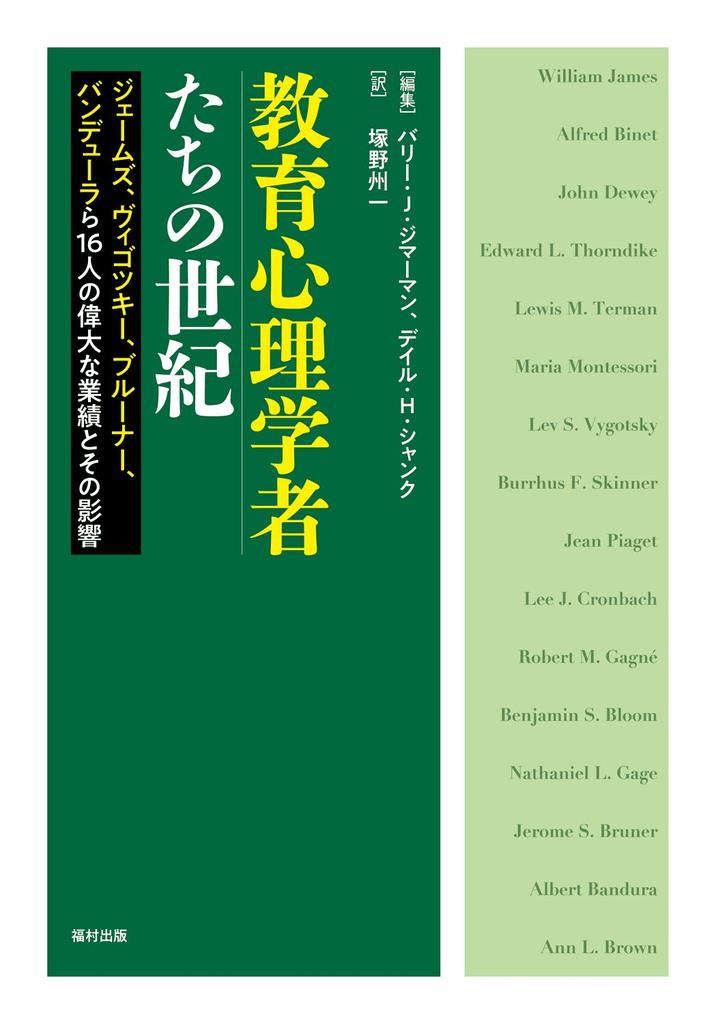
A Century of Educational Psychologists: The Great Achievements and Influences of 16 People, Including James, Vygotsky, Bruner, and Bandura


Descriere
Through the achievements of 16 researchers, including Dewey, Piaget, and Bruner, this course examines in detail the development of educational and developmental psychology, from its philosophical foundations in the late 19th century to the current state of research in the 21st century.
Table of Contents Preface to the Japanese Edition (Barry J. Zimmerman)
I. The Beginnings: 1890–1920 Chapter 1: Educational Psychology from 1890 to 1920 (Vernon C. Hall/Syracuse University) Social Contexts Closely Related to Educational Psychology The Field of Educational Psychology Educational Psychology in 1920
Chapter 2: William James: Father of Our United States (Frank Pajares/Emory University) A Life of Love and Research Contributions to Psychology William James and Educational Psychology The Jamesian Tradition Acknowledgments
Chapter 3: Alfred Binet's Contributions to Educational Psychology (Linda Jarvin, Robert J. Stern) Berg/Yale University) Theory and Research: Major Contributions to Education Influence on the Field of Educational Psychology Binet: A Pioneer Ahead of His Time
Chapter 4: Dewey's Development of Psychology (Eric Bredo/University of Virginia) Biographical Background New Psychology Self-Actualization: The Role of Cognition, Emotion, and Will The Influence of William James and Darwin Criticism of the Reflex Arc Concept The Theory of Emotion How Do We Think? Democracy and Education Conclusion
Chapter 5: E. L. Thorndike's Enduring Contributions to Educational Psychology (Richard E. Mayer/University of California, Santa Barbara) Who Was E. L. Thorndike? Brief Biography Thorndike's Enduring Contributions to Ideas in Educational Psychology Thorndike's Enduring Contributions to the Achievements of Educational Psychology Thorndike's Enduring Contributions to the Value of Educational Psychology Recognition of Thorndike's Enduring Contributions Conclusion Acknowledgments
Chapter 6: Lewis M. Terman: Pioneer in the Development of Ability Testing (John F. Feldusen/Purdue University) Terman's Adolescence and Education Highlights of Terman's Stanford Career Major Psychological Accomplishments Evaluation of Terman's Impact on Psychology, Education, and Schools Terman's Enduring Legacy
Chapter 7: Maria Montessori: Contributions to Educational Psychology (Gerald L. Guteck/Loyola University Chicago) Biographical Overview Montessori's Psychological Contributions to Education Evaluating Montessori's Impact Conclusion: Montessori's Legacy in the Field
II. The Rise of Education: 1920-1960 Chapter 8. The Rise of Educational Psychology: 1920-1960 (J. William Asher/Purdue University) Educational Psychology in the 1920s and 1930s Educational Psychology in the 1940s Educational Psychology in the 1950s Summary
Chapter 9. Lev S. Vygotsky's Educational Theory: Cultural-Historical, Interpersonal, and Individual Approaches to Development (Jonathan Tudge and Cheryl Scrimshire/University of North Carolina at Greensboro) Vygotsky's Life Overview Psychological Contributions to Education Evaluation Conclusion Acknowledgments
Chapter 10: B.F. Skinner: A Behavior Analyst in Educational Psychology (Edward K. Morris/University of Kansas) Intellectual, Cultural, and Personal Context Experimental Behavior Analysis Conceptual Behavior Analysis Applied Behavior Analysis Education Conclusion Acknowledgments
Chapter 11: Jean Piaget: Learning Research and American Education (C.J. Brainerd/University of Arizona) Piaget's Academic Life Child Learning I: Piaget on the Learning-Development Relationship Child Learning II: Piaget on Teaching Methods Piagetian Theory and Learning Theories: Additional Notes
Chapter 12: Lee J. Cronbach's Contributions to Educational Psychology (Hagai Coopermintz/University of Colorado, Boulder) Lee J. Cronbach A Brief Biography Measurement Issues Interactional Approach Program Evaluation Lee Cronbach's Legacy
Chapter 13: The Legacy of Robert Mills Gagné (Peggy A. Ertmer/Purdue University, Marcy P. Driscoll, Walter W. Wager/Florida State University) The Influence of Historical Context The Influence of Sociocultural Context Constructing a Legacy The Influence of a Legacy Assessing the Impact of a Legacy Conclusion
III: Contemporary Educational Psychology: 1960 to the Present Chapter 14: Contemporary Educational Psychology: 1960 to the Present (Michael Pressley/Michigan State University, Alicia D. Roeirig/University of Notre Dame) Educational Psychology at the End of the 20th Century Books Summarizing Contemporary Educational Psychology Journal of Educational Psychology: 1997-98 Educational Psychology in the Early 1960s The Cognitive Transformation in Contemporary Educational Psychology Final Comments Acknowledgments
Chapter 15: Benjamin S. Bloom: His Life, Research, and Legacy (Lauryn W. Anderson/University of South Carolina) His Life His Research His Legacy Acknowledgments
Chapter 16: Works in Pasteur's Quadrant: N. L. Gage's Contributions to Educational Psychology (David C. Berliner/Arizona State University) Background Contribution 1: The Handbook of Teaching Research "The Teaching Process" Contribution 2: Stanford University Center for the Research and Development of Teaching Contribution 3: The Dulles Conference Several Additional Contributions Conclusion Acknowledgments
Chapter 17: From "The Teaching Process" to "The Culture of Teaching": An Intellectual Biography of Jerome Bruner's Contributions to Education (Nancy C. Luckehaus, University of Southern California; Patricia M. Greenfield, University of California, Los Angeles) Sources and Perspectives Psychology and Anthropology in Bruner's Biography Events Leading to "The Teaching Process" The Educational Process: A Structuralist Approach The Role of Cognitive Development Culture, Cognitive Development, and Education Man, the Course of Learning (MACOS) Head Start and the 1960s The End of Man, the Course of Learning (MACOS) Narrative and Cultural Psychology The Relevance of Education to Cultural Psychology Bruner's Legacy to Educational Psychology
Chapter 18: Albert Bandura's Research Achievements and Contributions to Educational Psychology (Barry J. Zimmerman/Graduate Center, City University of New York; Dale H. Shank/North Carolina) (University of Greensboro, IL) As a Researcher Bandura's Contributions to Human Development and Education Evaluating Bandura's Contributions to the Field of Education Bandura's Legacy
Chapter 19: Anne L. Brown: Developing a Theoretical Model of Learning and Instruction (Annemarie Sullivan Palincsar/University of Michigan) The Role of Strategy Activity in Underperformance Basic Research on Text Comprehension Reciprocal Teaching Research Fostering a Community of Learners
[Authors] Vernon C. Hall C. Hall: Syracuse University Frank Pajares: Emory University Linda Jarvin: Yale University Robert J. Sternberg: Yale University Eric Bredo: University of Virginia Richard E. Mayer: University of California, Santa Barbara John F. Feldhusen: Purdue University Gerald L. Gutek: Loyola University, Chicago J. William Asher: Purdue University Jonathan Tudge: University of North Carolina at Greensboro Sheryl Scrimsher: University of North Carolina at Greensboro Edward K. Morris Morris, University of Kansas C. J. Brainerd, University of Arizona Haggai Kupermintz, University of Colorado at Boulder Peggy A. Ertmer, Purdue University Marcy P. Driscoll, Florida State University Walter W. Wager, Florida State University Michael Pressley, Michigan State University Alysia D. Roehrig, University of Notre Dame Lorin W. Anderson, University of South Carolina David C. Berliner, Arizona State University Nancy C. Lutkehaus, University of Southern California Patricia M. Greenfield: University of California, Los Angeles Barry J. Zimmerman: City University of New York Graduate Center Dale H. Schunk: University of North Carolina at Greensboro Annemarie Sullivan Palincsar: University of Michigan
[Translator's Note] *As of the time of first publication Shuichi Tsukano Professor Emeritus, Toyama University, Ph.D. in Psychology Born in Niigata Prefecture. Withdrew from the doctoral program in Educational Psychology at the Graduate School of Education, Tohoku University in 1970. He served as Professor at Toyama University, Dean of the Faculty of Education and Dean of the Graduate School of Education, and Specially Appointed Professor at Rissho University before retiring in 2010. Major works: "An examination of the process of change in self-valuation in the past, present, and future and its determining factors" (Kazama Shobo), edited and written "Miruyomu Lifelong Developmental Psychology" and "Miruyomu Lifelong Clinical Psychology" (both Kitaoji Shobo), co-translated "Growth and Development of School Children" (Meiji Tosho Publishing), "New Learning Psychology" and "Guidance on Self-Regulated Learning" (both Kitaoji Shobo), edited and translated "Theory of Self-Regulated Learning", "Practice of Self-Regulated Learning", "Self-Regulated Learning and Motivation" (all Kitaoji Shobo), co-supervised translation of "Handbook of Self-Regulated Learning" (Kitaoji Shobo)